Pearson Edexcel · GCSE · Business
Course version: 1BS0 · Version from Sept 2017
The concept and calculation of: ● revenue ● fixed and variable costs ●…
Full specification wording
Business revenues, costs and profits: The concept and calculation of: ● revenue ● fixed and variable costs ● total costs ● profit and loss ● interest ● break even level of output ● margin of safety.
Understanding financial metrics is vital for assessing business performance.
Checked against the Pearson Edexcel 1BS0 specification (opens in a new tab) on .
- Point 1 of 2
- 4 key terms
Study notes
From the checked teaching notes for this specification point.
The idea
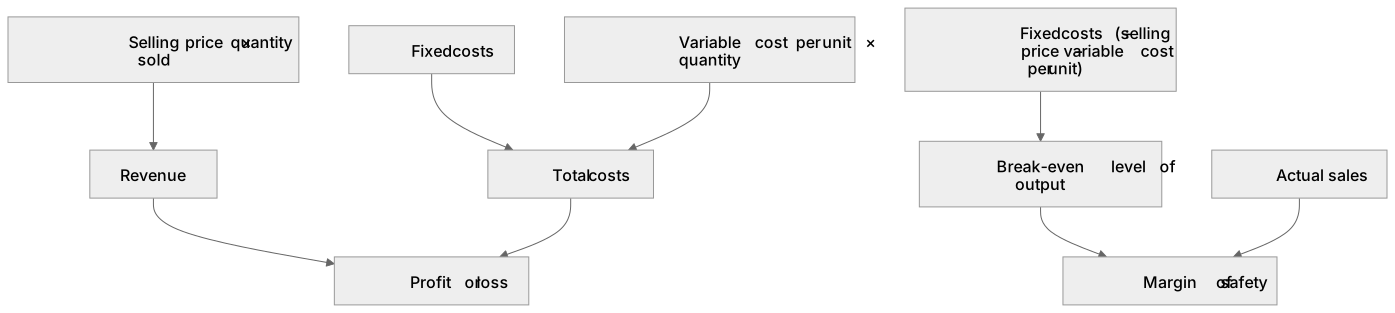
Understanding financial metrics is vital for assessing business performance. Revenue is calculated as selling price multiplied by quantity sold. Total costs combine fixed costs, which remain constant regardless of output (like rent), and variable costs, which change with production levels (like raw materials). Profit or loss is determined by subtracting total costs from revenue. Interest is the cost of borrowing or reward for saving, calculated as a percentage of the principal amount. The break-even level of output is where total revenue equals total costs, meaning neither profit nor loss is made; it is calculated by dividing fixed costs by the contribution per unit. Finally, the margin of safety measures how much actual sales can fall before reaching the break-even point, calculated as actual sales minus break-even sales.
What earns the marks
- Calculate total revenue using the formula: selling price × quantity sold.
- Determine total costs by adding fixed costs to total variable costs (variable cost per unit × quantity).
- Calculate profit or loss by subtracting total costs from total revenue, ensuring negative figures are clearly identified as a loss.
- Compute the break-even level of output using the formula: fixed costs / (selling price - variable cost per unit).
- Calculate the margin of safety by subtracting the break-even level of output from the current or projected level of output.
- Calculate interest on loans by applying the percentage interest rate to the total borrowed amount.
Common mistakes and how to put them right
Confusing revenue with profit.
Put it right by stating that revenue is the total money received from sales, whereas profit is revenue minus total costs.
Including variable costs in fixed costs.
Put it right by categorising costs that change with output strictly as variable costs.
Calculating margin of safety in monetary value instead of units.
Put it right by ensuring the margin of safety is expressed as a number of units of output unless revenue is specifically requested.
Exam tips
- Always show your working for calculations, as marks are often awarded for the correct method even if the final answer is wrong.
- Remember to include the correct units in your final answer, such as £ for revenue and costs, or 'units' for break-even output.
- When defining break-even, explicitly state that it is the point where total revenue exactly equals total costs, resulting in zero profit.
Try the lesson
The start of the Business revenues, costs and profits: The concept and calculation of: ● revenue ● fixed and variable costs ● total costs ● profit and loss ● interest ● break even level of output ● margin of safety. lesson, made from checked teaching notes for this specification point.
Have a go first
A business sells 400 units of a product at a price of £15 each. What is the total revenue for the business?
Listen
Understanding financial metrics is vital for assessing business performance. Revenue is calculated as selling price multiplied by quantity sold. Total costs combine fixed costs, which remain constant regardless of output (like rent), and variable costs, which change with production levels (like raw materials). Profit or loss is determined by subtracting total costs from revenue. Interest is the cost of borrowing or reward for saving, calculated as a percentage of the principal amount. The break-even level of output is where total revenue equals total costs, meaning neither profit nor loss is made; it is calculated by dividing fixed costs by the contribution per unit. Finally, the margin of safety measures how much actual sales can fall before reaching the break-even point, calculated as actual sales minus break-even sales. A strong answer earns marks for these points. Calculate total revenue using the formula: selling price × quantity sold. Determine total costs by adding fixed costs to total variable costs (variable cost per unit × quantity). Calculate profit or loss by subtracting total costs from total revenue, ensuring negative figures are clearly identified as a loss. Compute the break-even level of output using the formula: fixed costs / (selling price - variable cost per unit). A common slip: Confusing revenue with profit. Instead, stating that revenue is the total money received from sales, whereas profit is revenue minus total costs. Exam tip: Always show your working for calculations, as marks are often awarded for the correct method even if the final answer is wrong.
See it
Key words
Say what each word means before you turn the card.
Revenue
Try answering aloud or in your head before turning the card.
Total costs
Try answering aloud or in your head before turning the card.
Break-even level of output
Try answering aloud or in your head before turning the card.
Margin of safety
Try answering aloud or in your head before turning the card.
See every definition
- Revenue
- The total money received from sales, calculated as selling price multiplied by quantity sold.
- Total costs
- Fixed costs, which remain constant regardless of output, added to variable costs, which change with production levels.
- Break-even level of output
- The level of output where total revenue equals total costs, meaning neither profit nor loss is made.
- Margin of safety
- A measure of how much actual sales can fall before reaching the break-even point, calculated as actual sales minus break-even sales.
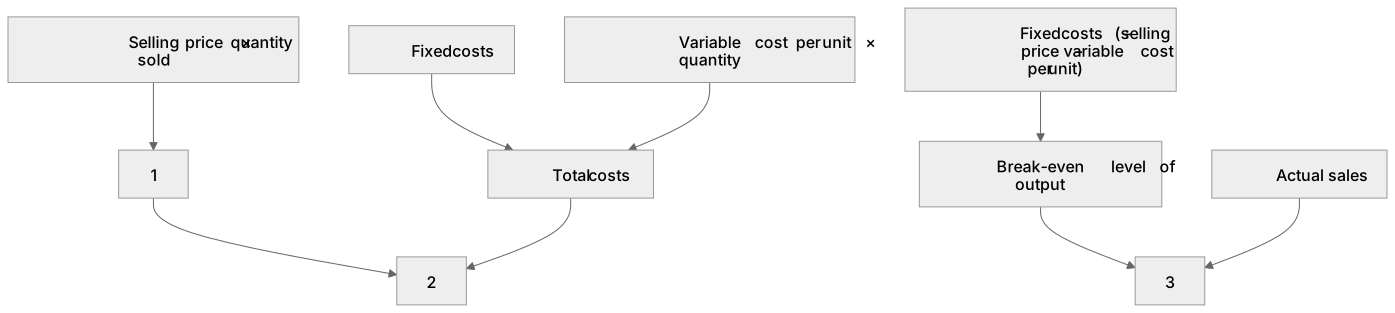
Label the diagram
Some boxes have lost their names. Pick the right name for each number.
1Box 1
2Box 2
3Box 3
There is more to this lesson
The full lesson goes on to check your understanding and help you earn the marks. Create a free account to carry on, with your progress saved.
A week of Premium from your first lesson · Then the free plan continues · No card, no charge
Test your understanding of Business revenues, costs and profits: The concept and calculation of: ● revenue ● fixed and variable costs ● total costs ● profit and loss ● interest ● break even level of output ● margin of safety.
Active recall beats re-reading. Take an instant quiz now to test what you’ve learned and lock it into long-term memory.
A week of Premium from your first lesson · Then the free plan continues · No card, no charge